 Add to Chrome
 Add to Firefox
 Add to Edge
Fast KVzip: Efficient and Accurate LLM Inference with Gated KV Eviction
Jan 25, 2026
Efficient key-value (KV) cache management is crucial for the practical deployment of large language models (LLMs), yet existing compression techniques often incur a trade-off between performance degradation and computational overhead. We propose a novel gating-based KV cache eviction method for frozen-weight LLMs that achieves high compression ratios with negligible computational cost. Our approach introduces lightweight sink-attention gating modules to identify and retain critical KV pairs, and integrates seamlessly into both the prefill and decoding stages. The proposed gate training algorithm relies on forward passes of an LLM, avoiding expensive backpropagation, while achieving strong task generalization through a task-agnostic reconstruction objective. Extensive experiments across the Qwen2.5-1M, Qwen3, and Gemma3 families show that our method maintains near-lossless performance while evicting up to 70% of the KV cache. The results are consistent across a wide range of tasks, including long-context understanding, code comprehension, and mathematical reasoning, demonstrating the generality of our approach.

Oops, Wait: Token-Level Signals as a Lens into LLM Reasoning
Jan 24, 2026The emergence of discourse-like tokens such as "wait" and "therefore" in large language models (LLMs) has offered a unique window into their reasoning processes. However, systematic analyses of how such signals vary across training strategies and model scales remain lacking. In this paper, we analyze token-level signals through token probabilities across various models. We find that specific tokens strongly correlate with reasoning correctness, varying with training strategies while remaining stable across model scales. A closer look at the "wait" token in relation to answer probability demonstrates that models fine-tuned on small-scale datasets acquire reasoning ability through such signals but exploit them only partially. This work provides a systematic lens to observe and understand the dynamics of LLM reasoning.
Privacy Collapse: Benign Fine-Tuning Can Break Contextual Privacy in Language Models
Jan 21, 2026We identify a novel phenomenon in language models: benign fine-tuning of frontier models can lead to privacy collapse. We find that diverse, subtle patterns in training data can degrade contextual privacy, including optimisation for helpfulness, exposure to user information, emotional and subjective dialogue, and debugging code printing internal variables, among others. Fine-tuned models lose their ability to reason about contextual privacy norms, share information inappropriately with tools, and violate memory boundaries across contexts. Privacy collapse is a ``silent failure'' because models maintain high performance on standard safety and utility benchmarks whilst exhibiting severe privacy vulnerabilities. Our experiments show evidence of privacy collapse across six models (closed and open weight), five fine-tuning datasets (real-world and controlled data), and two task categories (agentic and memory-based). Our mechanistic analysis reveals that privacy representations are uniquely fragile to fine-tuning, compared to task-relevant features which are preserved. Our results reveal a critical gap in current safety evaluations, in particular for the deployment of specialised agents.
What Defines Good Reasoning in LLMs? Dissecting Reasoning Steps with Multi-Aspect Evaluation
Oct 23, 2025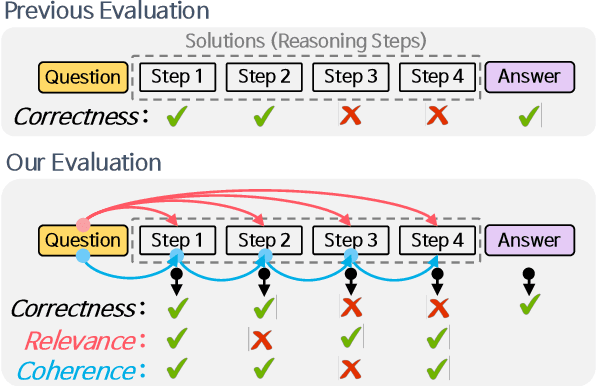
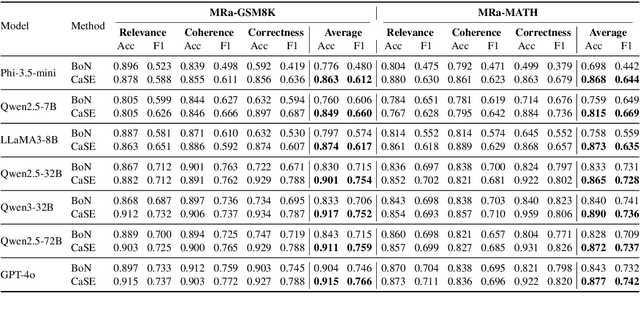
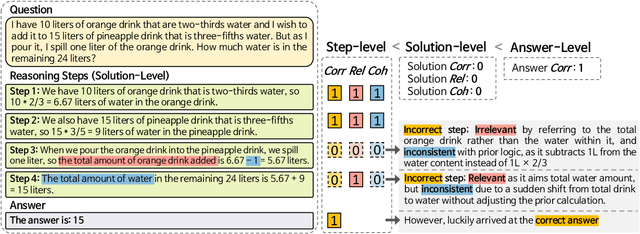
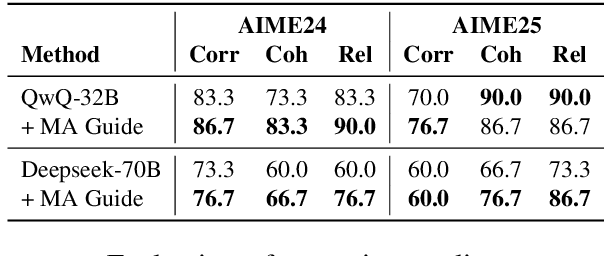
Evaluating large language models (LLMs) on final-answer correctness is the dominant paradigm. This approach, however, provides a coarse signal for model improvement and overlooks the quality of the underlying reasoning process. We argue that a more granular evaluation of reasoning offers a more effective path to building robust models. We decompose reasoning quality into two dimensions: relevance and coherence. Relevance measures if a step is grounded in the problem; coherence measures if it follows logically from prior steps. To measure these aspects reliably, we introduce causal stepwise evaluation (CaSE). This method assesses each reasoning step using only its preceding context, which avoids hindsight bias. We validate CaSE against human judgments on our new expert-annotated benchmarks, MRa-GSM8K and MRa-MATH. More importantly, we show that curating training data with CaSE-evaluated relevance and coherence directly improves final task performance. Our work provides a scalable framework for analyzing, debugging, and improving LLM reasoning, demonstrating the practical value of moving beyond validity checks.
Dr.LLM: Dynamic Layer Routing in LLMs
Oct 14, 2025Large Language Models (LLMs) process every token through all layers of a transformer stack, causing wasted computation on simple queries and insufficient flexibility for harder ones that need deeper reasoning. Adaptive-depth methods can improve efficiency, but prior approaches rely on costly inference-time search, architectural changes, or large-scale retraining, and in practice often degrade accuracy despite efficiency gains. We introduce Dr.LLM, Dynamic routing of Layers for LLMs, a retrofittable framework that equips pretrained models with lightweight per-layer routers deciding to skip, execute, or repeat a block. Routers are trained with explicit supervision: using Monte Carlo Tree Search (MCTS), we derive high-quality layer configurations that preserve or improve accuracy under a compute budget. Our design, windowed pooling for stable routing, focal loss with class balancing, and bottleneck MLP routers, ensures robustness under class imbalance and long sequences. On ARC (logic) and DART (math), Dr.LLM improves accuracy by up to +3.4%p while saving 5 layers per example on average. Routers generalize to out-of-domain tasks (MMLU, GSM8k, AIME, TruthfulQA, SQuADv2, GPQA, PIQA, AGIEval) with only 0.85% accuracy drop while retaining efficiency, and outperform prior routing methods by up to +7.7%p. Overall, Dr.LLM shows that explicitly supervised routers retrofit frozen LLMs for budget-aware, accuracy-driven inference without altering base weights.
ClearFairy: Capturing Creative Workflows through Decision Structuring, In-Situ Questioning, and Rationale Inference
Sep 18, 2025Capturing professionals' decision-making in creative workflows is essential for reflection, collaboration, and knowledge sharing, yet existing methods often leave rationales incomplete and implicit decisions hidden. To address this, we present CLEAR framework that structures reasoning into cognitive decision steps-linked units of actions, artifacts, and self-explanations that make decisions traceable. Building on this framework, we introduce ClearFairy, a think-aloud AI assistant for UI design that detects weak explanations, asks lightweight clarifying questions, and infers missing rationales to ease the knowledge-sharing burden. In a study with twelve creative professionals, 85% of ClearFairy's inferred rationales were accepted, increasing strong explanations from 14% to over 83% of decision steps without adding cognitive demand. The captured steps also enhanced generative AI agents in Figma, yielding next-action predictions better aligned with professionals and producing more coherent design outcomes. For future research on human knowledge-grounded creative AI agents, we release a dataset of captured 417 decision steps.
Token Bottleneck: One Token to Remember Dynamics
Jul 09, 2025Deriving compact and temporally aware visual representations from dynamic scenes is essential for successful execution of sequential scene understanding tasks such as visual tracking and robotic manipulation. In this paper, we introduce Token Bottleneck (ToBo), a simple yet intuitive self-supervised learning pipeline that squeezes a scene into a bottleneck token and predicts the subsequent scene using minimal patches as hints. The ToBo pipeline facilitates the learning of sequential scene representations by conservatively encoding the reference scene into a compact bottleneck token during the squeeze step. In the expansion step, we guide the model to capture temporal dynamics by predicting the target scene using the bottleneck token along with few target patches as hints. This design encourages the vision backbone to embed temporal dependencies, thereby enabling understanding of dynamic transitions across scenes. Extensive experiments in diverse sequential tasks, including video label propagation and robot manipulation in simulated environments demonstrate the superiority of ToBo over baselines. Moreover, deploying our pre-trained model on physical robots confirms its robustness and effectiveness in real-world environments. We further validate the scalability of ToBo across different model scales.
Emergence of Text Readability in Vision Language Models
Jun 24, 2025We investigate how the ability to recognize textual content within images emerges during the training of Vision-Language Models (VLMs). Our analysis reveals a critical phenomenon: the ability to read textual information in a given image \textbf{(text readability)} emerges abruptly after substantial training iterations, in contrast to semantic content understanding which develops gradually from the early stages of training. This delayed emergence may reflect how contrastive learning tends to initially prioritize general semantic understanding, with text-specific symbolic processing developing later. Interestingly, the ability to match images with rendered text develops even slower, indicating a deeper need for semantic integration. These findings highlight the need for tailored training strategies to accelerate robust text comprehension in VLMs, laying the groundwork for future research on optimizing multimodal learning.
Leaky Thoughts: Large Reasoning Models Are Not Private Thinkers
Jun 18, 2025We study privacy leakage in the reasoning traces of large reasoning models used as personal agents. Unlike final outputs, reasoning traces are often assumed to be internal and safe. We challenge this assumption by showing that reasoning traces frequently contain sensitive user data, which can be extracted via prompt injections or accidentally leak into outputs. Through probing and agentic evaluations, we demonstrate that test-time compute approaches, particularly increased reasoning steps, amplify such leakage. While increasing the budget of those test-time compute approaches makes models more cautious in their final answers, it also leads them to reason more verbosely and leak more in their own thinking. This reveals a core tension: reasoning improves utility but enlarges the privacy attack surface. We argue that safety efforts must extend to the model's internal thinking, not just its outputs.
Aligned Novel View Image and Geometry Synthesis via Cross-modal Attention Instillation
Jun 13, 2025We introduce a diffusion-based framework that performs aligned novel view image and geometry generation via a warping-and-inpainting methodology. Unlike prior methods that require dense posed images or pose-embedded generative models limited to in-domain views, our method leverages off-the-shelf geometry predictors to predict partial geometries viewed from reference images, and formulates novel-view synthesis as an inpainting task for both image and geometry. To ensure accurate alignment between generated images and geometry, we propose cross-modal attention distillation, where attention maps from the image diffusion branch are injected into a parallel geometry diffusion branch during both training and inference. This multi-task approach achieves synergistic effects, facilitating geometrically robust image synthesis as well as well-defined geometry prediction. We further introduce proximity-based mesh conditioning to integrate depth and normal cues, interpolating between point cloud and filtering erroneously predicted geometry from influencing the generation process. Empirically, our method achieves high-fidelity extrapolative view synthesis on both image and geometry across a range of unseen scenes, delivers competitive reconstruction quality under interpolation settings, and produces geometrically aligned colored point clouds for comprehensive 3D completion. Project page is available at https://cvlab-kaist.github.io/MoAI.